




- 3x Growth in meaningful user actions YTD.
- +109% Daily Users for the new Art Discovery experience vs. legacy OVR.
- 91% Satisfaction for the AI Assistant, proving that speed does not sacrifice quality.
- Scalable, secure middleware for real-time responses
- Enhanced art engagement and exhibit navigation
- Premium app with seamless AI integration
Key Performance Highlights
- 3x Growth in meaningful user actions YTD.
- +109% Daily Users for the new Art Discovery experience vs. legacy OVR.
- 91% Satisfaction for the AI Assistant, proving that speed does not sacrifice quality.
Overview
Art Basel brings together galleries, artists, collectors, curators and art enthusiasts at major fairs around the world. Each show combines a vast collection of artworks with talks, private events, gallery presentations, hospitality and activity across the host city.
That richness is part of the appeal, but it also creates a practical problem. Visitors have a limited amount of time, different levels of access and very different interests. They need to understand what is happening, decide what matters to them and move through the fair without spending the day searching through lists or switching between tools.
Art Basel wanted to create a digital companion for the complete visit. It needed to support the essentials, including access, event discovery, scheduling and RSVPs, while using AI where it could make the experience genuinely more personal and useful. Just as importantly, the app had to complement the physical fair. Technology should help people engage more deeply with the art, not compete for their attention.
The brief was therefore much larger than adding a chatbot to an existing app. It required a new iOS product, a new content and integration layer, new AI services and a dependable way to bring together information held across Art Basel’s systems. The product also had to be ready for a fixed fair date, with the security and flexibility to support future shows and services.
The new Art Basel app launched ahead of Art Basel Miami Beach in 2024. UIC worked across product definition, architecture, backend and CMS development, iOS engineering, AI integration, quality assurance and delivery, collaborating with Art Basel, Microsoft, Valorem Reply and Art Basel’s design partner.
How did we deliver impactful embedded AI solutions in just months? By using our proprietary PRIME AI framework. This high-velocity delivery model prioritizes rapid workshops and tangible product increments over strategy-heavy slide decks.
Defining a product around the visit
The programme began by turning a broad product vision into the journeys that mattered most. UIC worked with Art Basel to map the experience before, during and around a fair, alongside the content, identity and operational systems needed to support it.
The initial scope covered everything from sign-in and onboarding to event discovery, personal schedules, gallery information, tickets, VIP access and AI-assisted recommendations. Each area contained its own dependencies. Recommendations had to reflect a visitor’s interests and access, RSVPs had to remain connected to live event data, and AI answers had to be current, appropriate and grounded in dependable Art Basel information.
With a fixed launch date, the team treated prioritisation as a continuous product decision. Features were broken into testable increments, dependencies were resolved early and lower-value complexity was deferred where it could put the core experience at risk. Product, design and engineering worked in shared sprints, with frequent technical sessions, UX reviews, demonstrations and backlog decisions keeping the different organisations aligned.
This allowed the app and its emerging AI capability to develop while the foundations for identity, data and content were built in parallel.
Making a complex fair easier to explore
The main experience was organised around what a visitor is trying to do, rather than the systems or teams behind the fair.
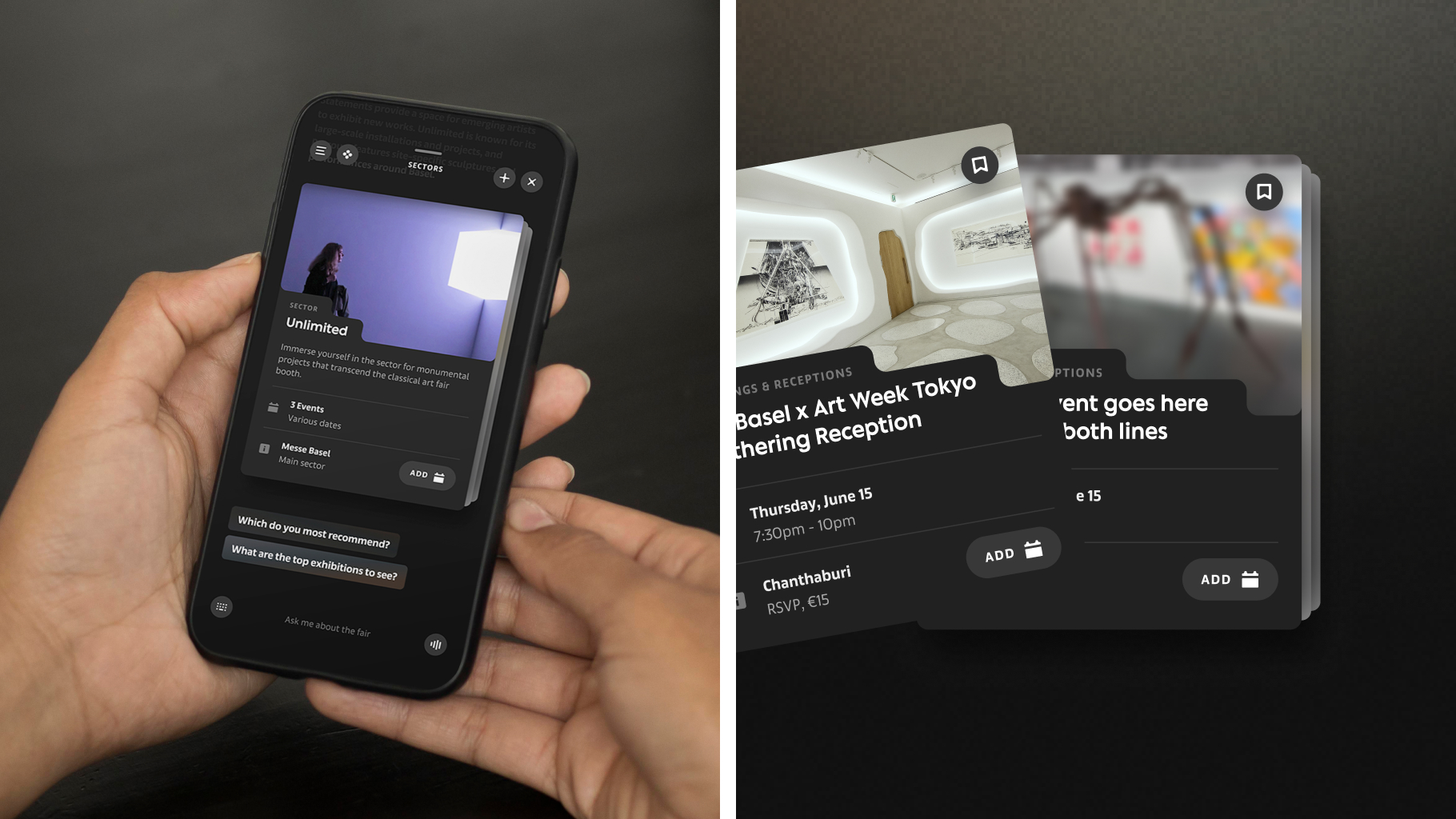
Onboarding captures interests that can be used to shape recommendations. The Discover experience brings together events, galleries, dining and highlights from the host city. Detailed pages give visitors the information needed to make a decision, including dates and times, location, access, participating galleries and related activity.
Visitors can add and remove events, build a schedule across the days of the fair, RSVP where required and synchronise selected events with their personal calendar. Account and access journeys support registration, secure sign-in and the needs of VIP guests.
These functions are conventional by design. They reduce the practical effort of attending a large event and create a dependable core around the more experimental AI features. A recommendation becomes useful because it can lead directly to an event, gallery or action. The AI does not sit in a separate novelty experience. It connects back into the product.
An AI Companion grounded in Art Basel’s own information
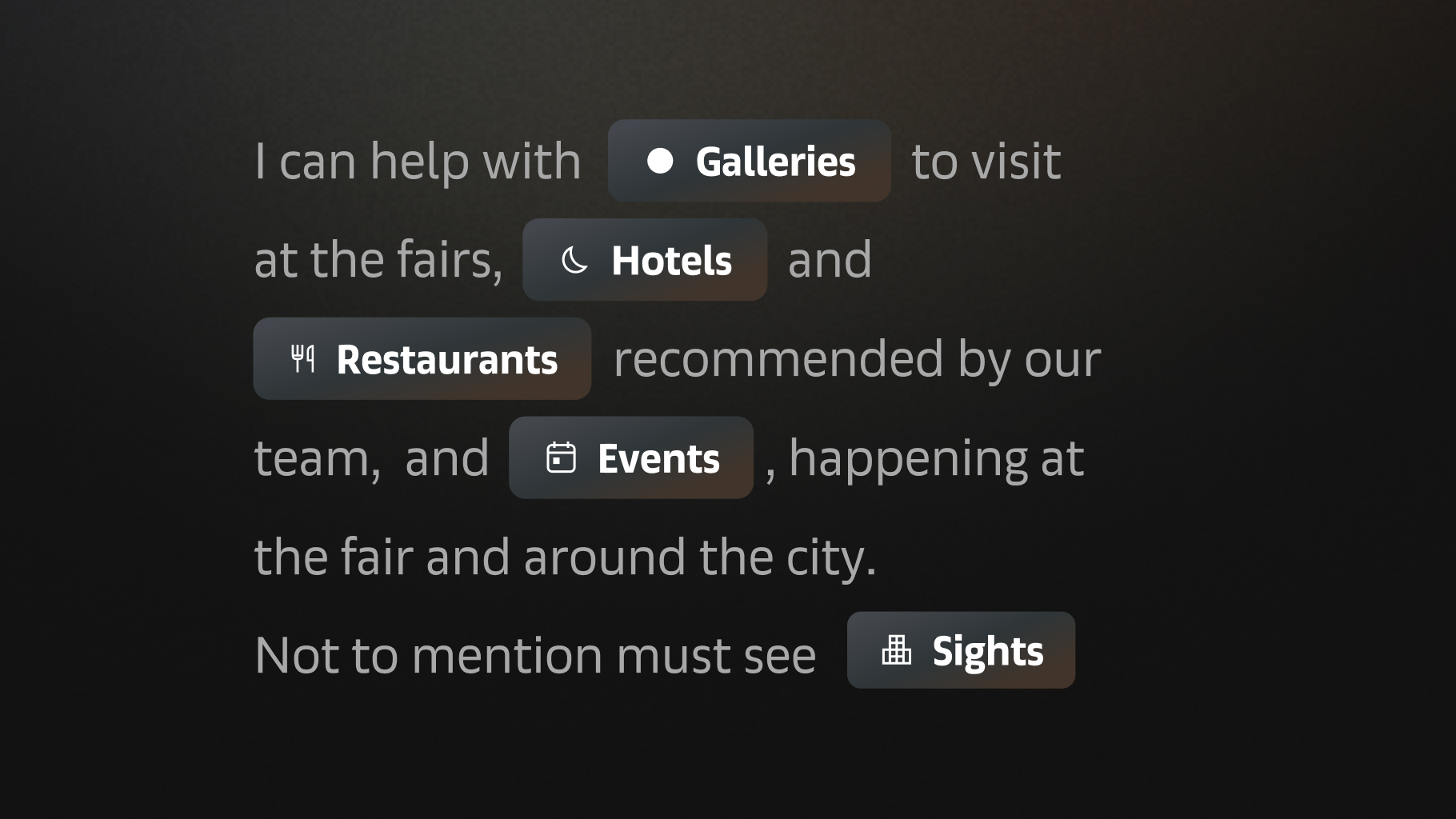
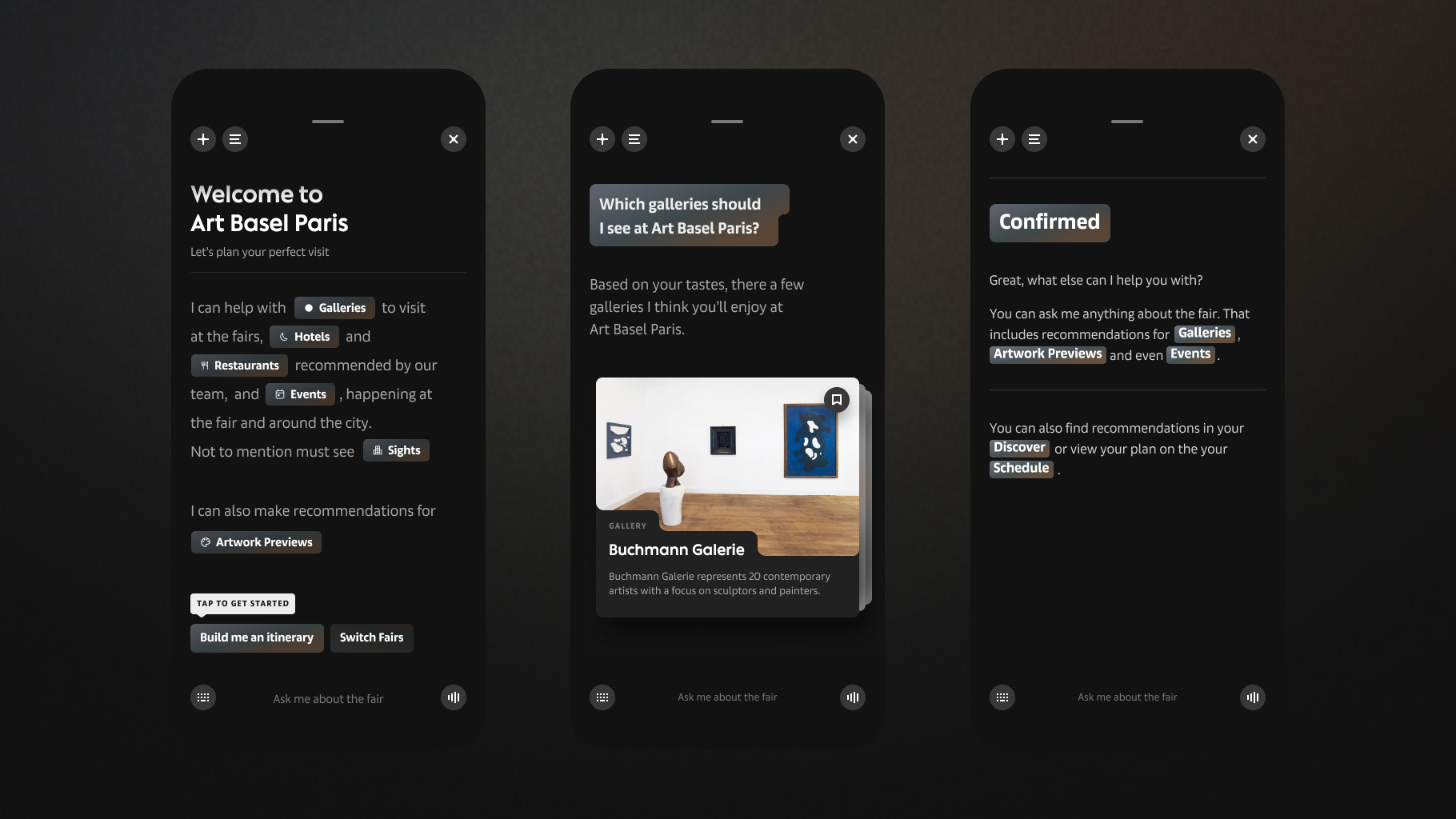
The Art Basel Companion gives visitors a conversational way to explore the fair. They can ask an open question or begin with a suggested prompt, using text or voice. The Companion can answer practical questions about the show, explain artists and galleries, surface events and cultural highlights, and recommend what to see based on a visitor’s stated interests.
The challenge was not simply generating fluent answers. The Companion needed to respond using current, verified Art Basel information, recognise the context of the fair and avoid inventing an answer when reliable information was not available.
UIC built the retrieval and integration services that connect the language model to Art Basel’s content and operational data. Information from events, galleries, artworks, restaurants and city highlights is indexed and made available through specific functions rather than being left to the model’s general knowledge. User preferences and relevant account information can be included when a question requires a more personal response.
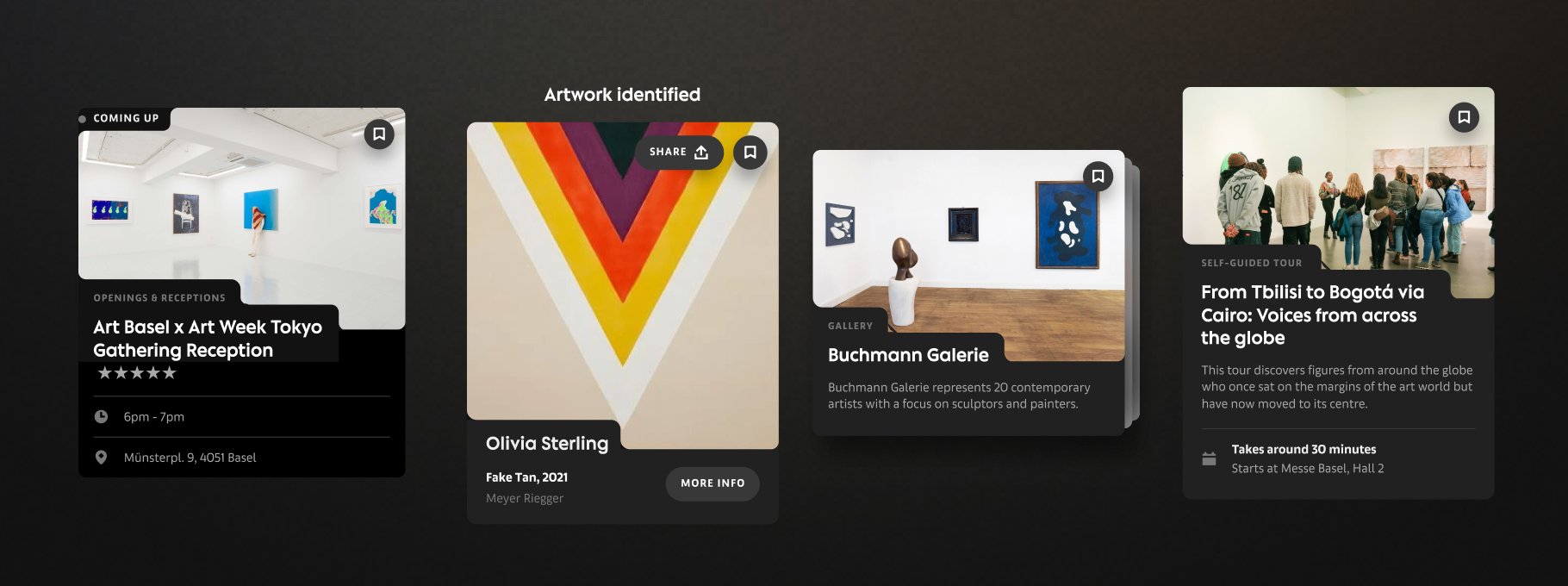
The experience can also return structured content, such as event or gallery cards, rather than reducing every answer to a paragraph of text. This allows a conversation to lead naturally into the next action, including adding an event to a schedule or opening a detailed record.
Guardrails were treated as product requirements. The Companion stays within the Art Basel context, follows the brand’s tone, declines inappropriate or unrelated requests and provides a useful fallback when it cannot answer confidently. Conversation history is maintained within the session so visitors can ask follow-up questions without starting again.
Recognising an artwork in around two seconds
Art Basel Lens brings AI into the moment of discovery. A visitor can point their phone at an artwork on display and receive the artist, artwork and exhibiting gallery information in real time. From there, they can learn more, share the work or contact the gallery.
Making this work inside a live fair is considerably harder than matching clean catalogue images. Photographs may be taken from an angle, in poor lighting or with people standing between the camera and the work. Artworks also vary widely in scale, format and visual character.
The Lens pipeline isolates the artwork, creates an embedding and searches for a sufficiently strong match in a vector index. If the confidence threshold is met, the app returns the associated metadata. The complete process takes around two seconds.
Developed by Art Basel, UIC and Valorem Reply using Microsoft’s AI platform, Lens was introduced as a pilot across the Nova and Survey sectors at Art Basel Miami Beach. It was the first application of Microsoft’s AI computer vision technology in a global art fair context.
The value is not recognition for its own sake. Lens gives visitors an immediate route from visual interest to reliable context, while giving artists and galleries clearer attribution and another way for an interested collector to continue the conversation.
Connecting content, customer data and AI
Behind the app was a fragmented information landscape. Gallery, artwork, event and visitor data came from Microsoft Dynamics CRM, existing content systems and a specialist artwork database, with source material arriving as documents, presentations, images and PDFs. Much of it had not been structured for conversational search or real-time recommendations.
UIC created a central integration and content layer that could synchronise this information, enrich it with consistent metadata and make it available to the app and AI services through controlled APIs. A flexible CMS allows Art Basel teams to manage and enhance content without placing every change in a development queue.
The middleware handles application logic, user authentication, permissions, schedules, favourites, conversation data and the connections between the app and its source systems. This separation is important. The iOS interface does not need to understand where every piece of data originated, and an underlying service can change without forcing the entire product to be rebuilt.
The platform uses Azure AI Foundry services including Azure OpenAI and Azure AI Search, with Cosmos DB for structured and unstructured data, API Management for app interactions, and Azure Container Apps and Azure Functions for the serverless backend. Services operate within Art Basel’s Azure environment, with data encrypted in transit and at rest.
The architecture was designed for changing levels of demand across different cities and regulatory environments. Its cloud foundation gives Art Basel a reusable platform for future mobile, web and AI experiences.
A connected foundation for the visitor experience
The result is one product that joins practical event planning with more open-ended discovery. Visitors can browse the full programme, find galleries and artworks, create a personal itinerary, manage RSVPs and use AI to explore what interests them. Lens adds information at the point an artwork captures their attention, without requiring them to search for it manually.
For galleries and artists, the app creates more opportunities for accurate attribution, discovery and direct contact. For Art Basel teams, centralised data and editable content reduce manual handoffs, while the shared technical foundation can develop across fairs rather than being rebuilt for each event.
The product has also created a practical framework for future ideas. New services such as wayfinding, booking and year-round discovery can be added to the same content, identity and integration layer instead of beginning as isolated experiments.
“This app represents a significant step forward in enhancing the experience for our galleries, artists, and collectors, as well as paving the way for future innovations, including AI-driven solutions to elevate the customer experience further.”
Craig Hepburn, Chief Digital Officer, Art Basel
How we did it
By using our proprietary PRIME AI framework. This high-velocity delivery model prioritizes rapid workshops and tangible product increments over strategy-heavy slide decks.
Phase 1 & 2: Preparation & Research (The Sprint)
We didn’t spend months on discovery. We utilized short, focused workshops to immediately identify the commercial levers that would move the needle for Art Basel and its partners.
- Commercial Lever identified: Reclaiming the 70% engagement loss from legacy Online Viewing Rooms.
- Rapid Mapping: Quickly audited 20 years of unstructured data to create a technical foundation for AI in weeks, not months.
Phase 3: Implementation (Idea to Code)
We moved directly from Proof of Concept (PoC) to a production-ready ecosystem for the Miami Beach 2024 launch.
- The AI Chat Assistant: Grounded a GPT-4o model in verified fair data, moving from prototype to a 91% satisfaction-rated live product in a single cycle.
- Art Basel Lens: Deployed a beta computer-vision tool that delivers artwork metadata in under two seconds, proving that complex AI can be integrated seamlessly into luxury UI at pace.
Phase 4 & 5: Monitoring & Evolution (Live Impact)
The speed of delivery resulted in immediate, massive gains for the Miami Beach fair:
- Immediate Adoption: +37% increase in app downloads YoY.
- Engagement Surge: Average engagement time jumped +36% to nearly 13 minutes per user.
- Commercial ROI: Partner visibility on Gallery Detail Pages skyrocketed by +96%.
Fast-tracked delivery accelerated our feedback loop, enabling an enhanced UX architecture that allows users to seamlessly navigate between multiple global city fairs.
The PRIME Framework: Built for Speed
Phase |
Duration |
Outcome |
|---|---|---|
| Identify | Days | Rapid workshops to pinpoint “Value Levers” (e.g., Partner Visibility). |
| Build | Weeks | Moving from “Idea to Code”—deploying PoCs into testing environments. |
| Deliver | Months | Full-scale production launch across iOS and Android globally. |
“Our approach is simple: Less strategy, more delivery. With the PRIME framework, we identified Art Basel’s commercial opportunities and moved them from a workshop whiteboard to a global production environment in months, not years.”
“Thank you for your exceptional leadership and tireless effort in steering the team and the project to success. Your focus and dedication have truly inspired everyone involved and ensured we reached this milestone together.”
Alain Brusch, Global Head of Digital Platforms, Art Basel
“This app represents a significant step forward in enhancing the experience for our galleries, artists, and collectors, as well as paving the way for future innovations, including AI-driven solutions to elevate the customer experience further.
Thank you all for your hard work, collaboration, and passion. It’s been an incredible journey, and I look forward to celebrating further achievements together as we continue to transform our digital ecosystem.”
Craig Hepburn, Chief Digital Officer, Art Basel

