




- Two platform rebuilds
- Docs-as-code workflow
- Built to VISA security standards
- Developer Centre & Direct portal
- Next.js, React and TypeScript
- WCAG AA accessible design

Currencycloud provides cross-border and multi-currency financial infrastructure to businesses worldwide. Across 2022 and 2023, UIC Digital delivered two connected pieces of work for Currencycloud: a rebuild of its Developer Centre, and a full rebuild of Direct, its customer-facing payments platform. The second project began not long after Currencycloud’s acquisition by VISA, which brought a new set of security and architecture requirements into scope.
Project one: the Developer Centre
Understanding the existing product
Currencycloud’s API documentation site ran on WordPress, and even a small content change meant working through around ten steps in an outdated interface. There was no proper approval or staging process, so updates were slow and risky to make.
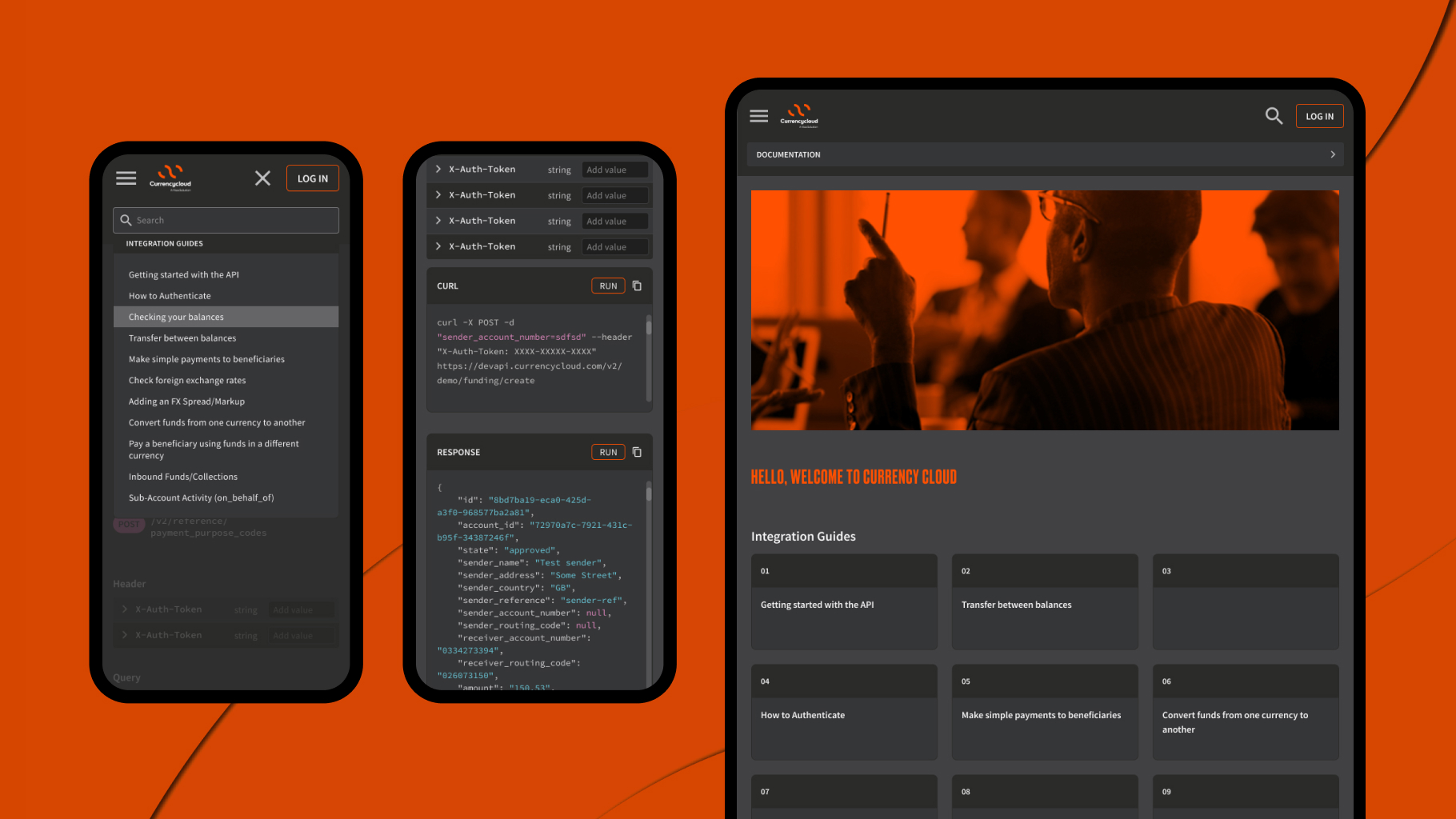
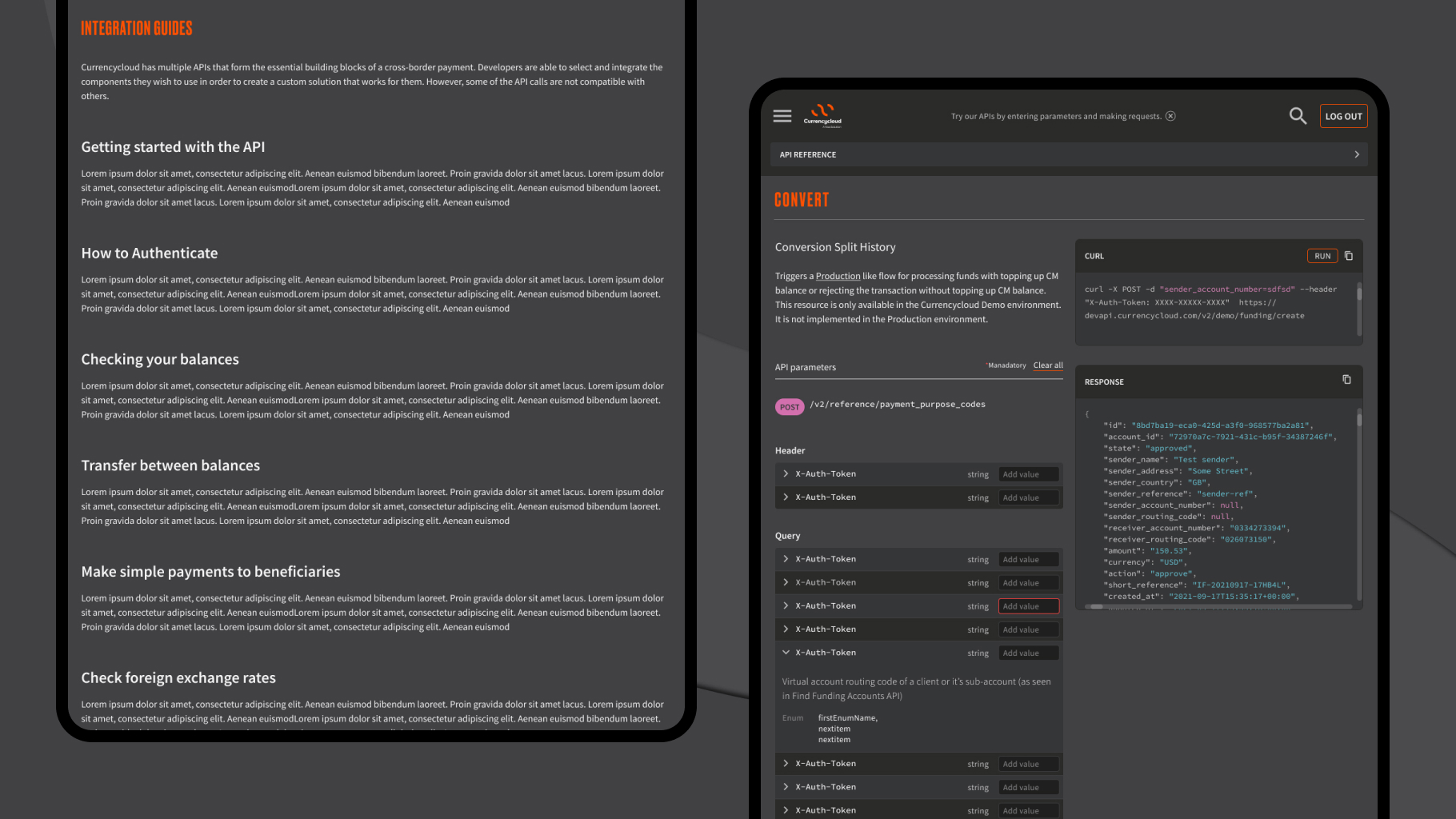
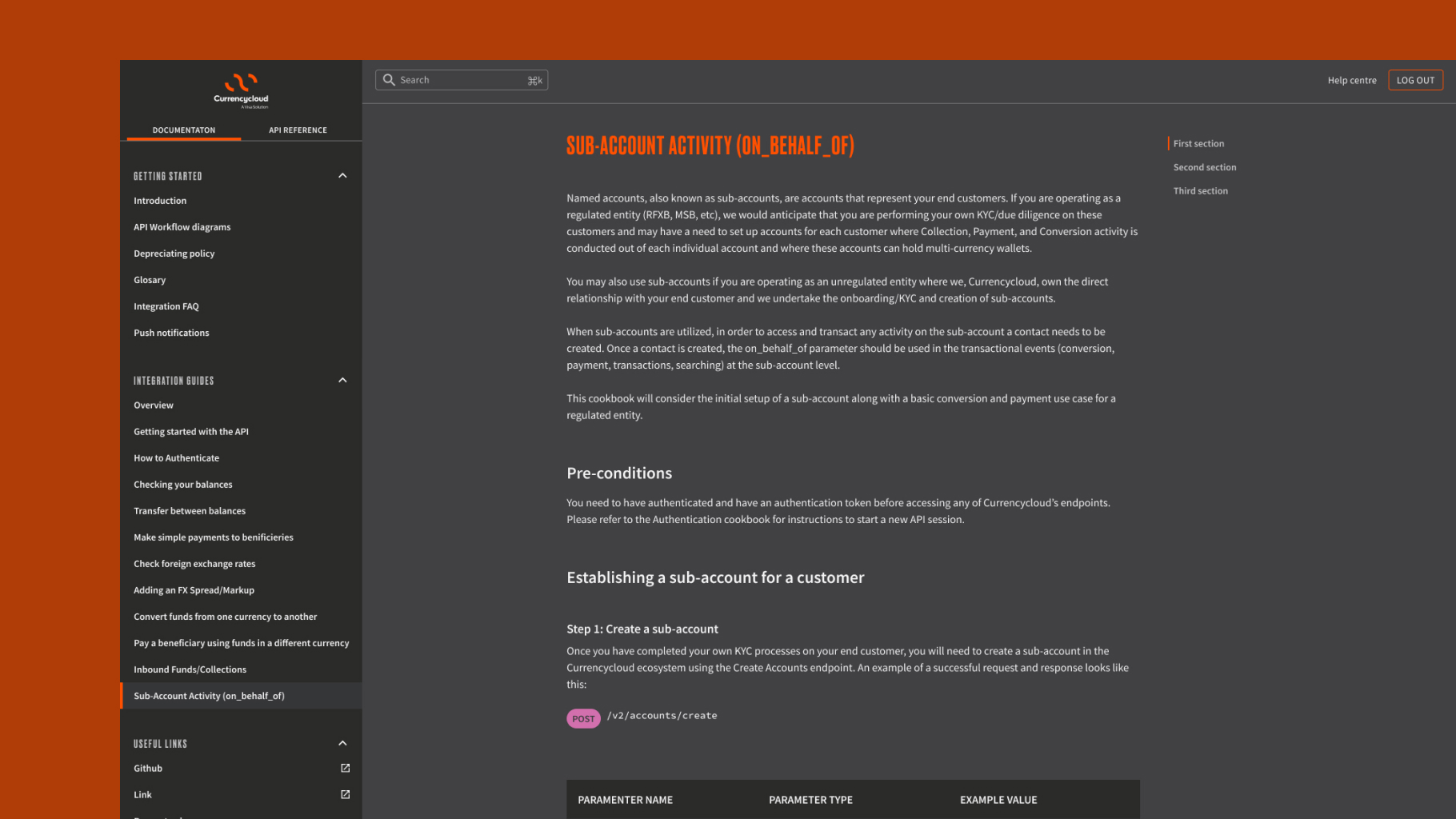
We started with a discovery call to map what the current platform did well, where it fell short, and what Currencycloud’s developers and business stakeholders needed from a replacement. Alongside reviewing the existing site’s structure (its API documentation, cookbooks, search and account features), we benchmarked it against Stripe and Postman, two products known for developer experience. That comparison surfaced specific features worth carrying over, including click to copy code snippets, deep linking to page sections, expandable panels and a clear operational status indicator.
From these sessions, Currencycloud’s priorities became clear: keep every existing feature, move off WordPress, adopt a docs-as-code approach with content written in Markdown and sourced from GitHub, add an approval process and deployment pipeline, and support multiple languages and a proper filter and search facility.
Defining the UX and design approach
With requirements agreed, we set out the assumptions that would shape the build: a fluid, three breakpoint responsive layout, a single continuous page for the main API reference, left hand primary navigation, and full WCAG AA compliance throughout. All page types on the existing site would carry over, though not necessarily in the same format.
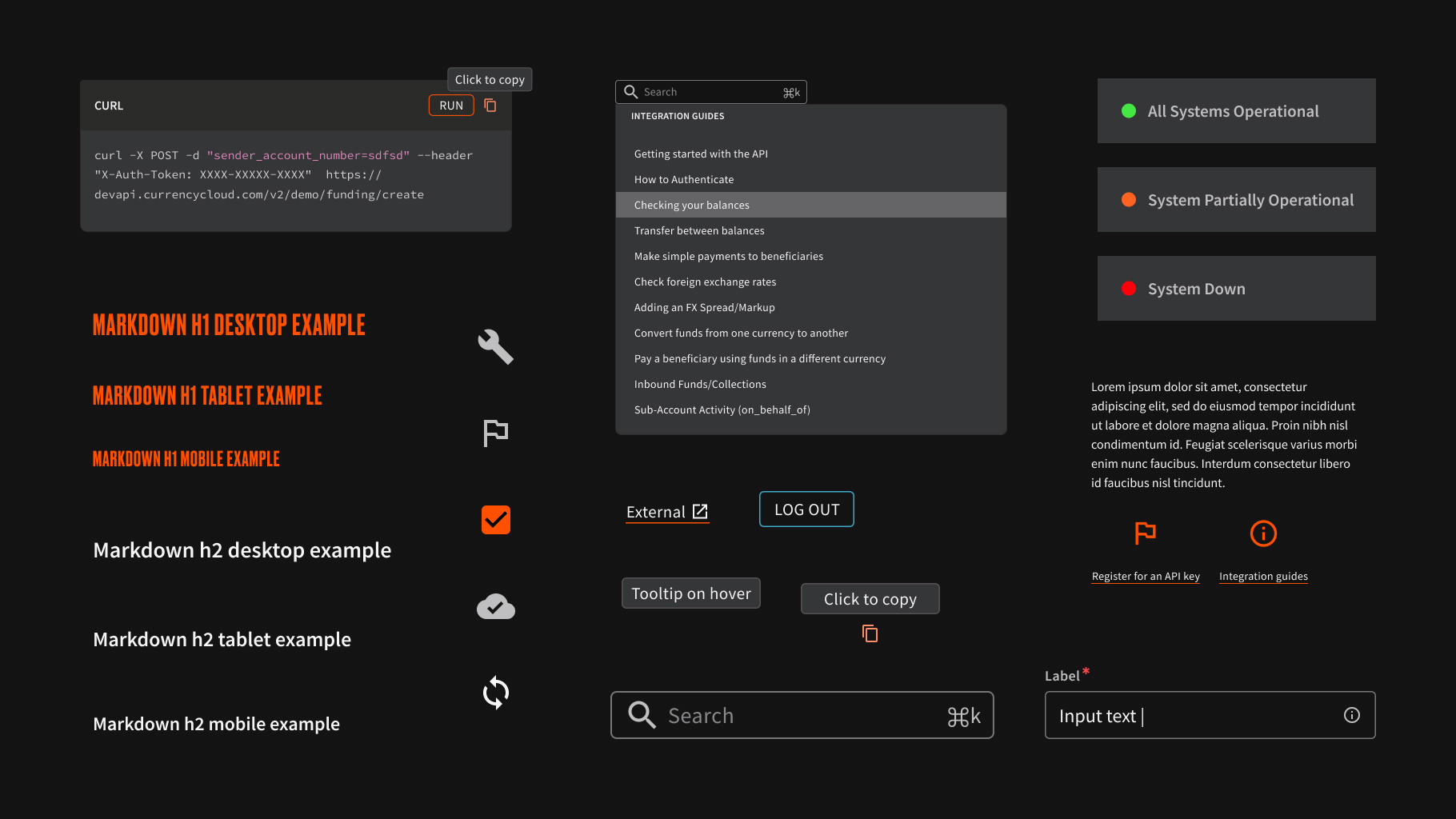
Visual design work focused heavily on accessibility. Currencycloud’s brand colours needed adapting for a dark theme without losing on-brand recognisability, so we tested colour contrast ratios against WCAG AA’s 4.5 minimum and found several existing combinations failed. Lowering the grey background’s luminosity by nine percentage points brought every combination up to standard. We also reviewed desaturated accent colours (drawing on Apple’s iOS light and dark theme palette as a reference point) and tested typefaces for legibility at small sizes, recommending Source Sans Pro as the default body font, Druk used sparingly for headings, and a dedicated monospace typeface for code.
The technical approach
The proposed solution was a single page web application built in HTML5 and JavaScript. Static content and API specifications would live as Markdown files and Swagger specs in a git repository, maintained directly by Currencycloud’s developers. Any change would trigger an automated ingestion process that generated the necessary HTML and pushed it to static file storage, removing the need for a CMS entirely. Search and filtering were handled by a dedicated app server, indexing the ingested content through a service such as ElasticSearch, with the frontend querying it via a REST endpoint.
Delivering the work
The project ran in three UX phases: formalising user stories and site architecture, building interactive wireframes for each key template (starting with primary navigation and responsive behaviour, then the main API page, static content, search results, registration and login), and finally defining responsive views for each template. Design and development followed in two week sprints, with regular reviews and sign off built into the schedule.
The result was a Developer Centre that gave Currencycloud’s team a genuinely faster way to publish and maintain documentation: content changes now go through GitHub rather than a ten step WordPress process, with staging and approval built in, alongside a modern, accessible interface for the developers using the API day to day.
Project two: the Direct platform rebuild
Where the platform started
Direct is Currencycloud’s authenticated customer portal, covering balances, currency conversion, payments, transfers, beneficiaries, bulk uploads, reporting and support. The existing product had been built across several different technologies over time, which made it increasingly hard to maintain, extend, or add new features to.
Discovery work identified a clear usability problem underneath the technical one: 88% of users weren’t finding what they needed on the existing platform, with the site’s deeply nested structure getting in the way of its two most important journeys, converting currency and making payments. Early priorities for the rebuild included simplifying the menu, surfacing quick actions on the dashboard, and reducing the number of clicks needed to complete common tasks.
A new set of security requirements
Currencycloud’s acquisition by VISA added a firm set of security and architecture requirements to the brief. The new platform needed a tiered architecture that separated the frontend from backend logic entirely: no business logic (authentication, 2FA verification) could sit in the UI layer, and no directly internet-facing layer could hold database connectivity. Static code analysis, OWASP-based dynamic testing, and a ban on copyleft open source licences were all built into the standard from the outset, with a formal penetration test run jointly by Currencycloud and VISA scheduled ahead of launch.
Discovery and structural audit
Rather than starting from a blank page, we ran a mini structural audit of the existing platform, cataloguing every template and feature it contained into a single reference: a full site map, a feature breakdown by page, and a key user task diagram grouping actions into login and profile management, entities (beneficiaries, accounts, contacts), and transactional actions with their history. This became the foundation for the backlog, alongside a short backend discovery running in parallel to properly understand the API endpoints and what the new middleware would need to support.
With the backlog created, user stories were sized and planned in priority order before the build began, and development ran on a two week agile sprint cadence throughout, with regular demos, daily stand-ups and sprint planning to adjust the plan as the project proceeded.
Building the frontend
The rebuilt frontend consolidated everything into a single, server-side rendered Next.js application with TypeScript. The stack included UI components documented and showcased in Storybook, React Router for navigation, React Query paired with Axios for talking to the REST API, React Context for global state, styled components carried over from the existing solution, and Jest for unit testing.
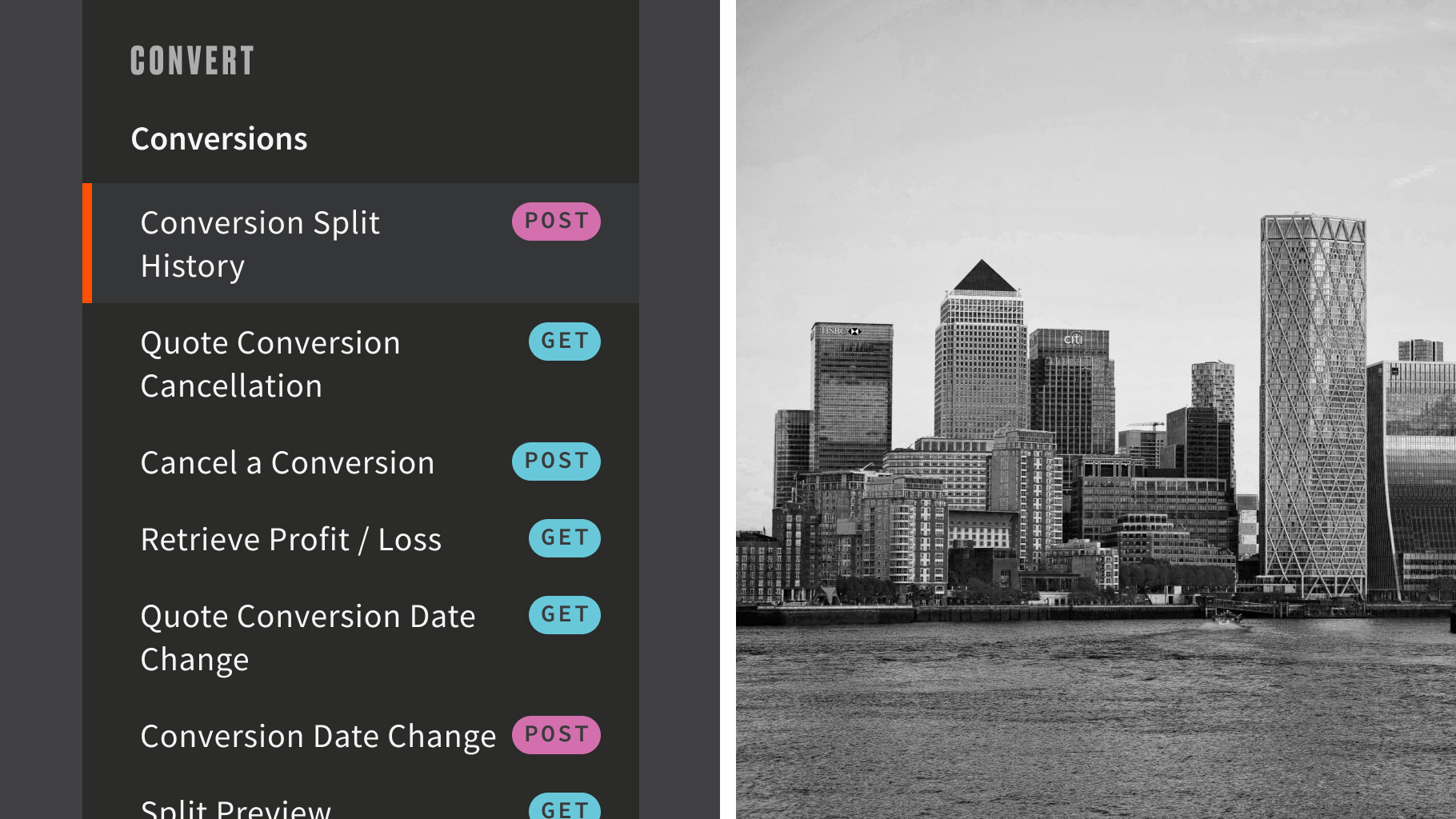
Development covered the full set of authenticated user actions: login, logout and profile management (including 2FA), adding and managing beneficiaries, accounts and contacts, currency conversion, payments and transfers (each with split and cancel actions), bulk upload, reporting, and support ticketing. Themes were built to support both the core consumer experience and white-label deployment under a separate subdomain.
Building the backend
Alongside the frontend, we built a new middleware backend application in Node.js and TypeScript to serve as the integration point between Currencycloud’s API services, authentication and 2FA services, and the new frontend, formatting and optimising data via a backend-for-frontend (BFF) REST API. This was orchestrated through WSO2 API Manager, allowing multiple first and third-party APIs to sit behind one interface, and hosted in AWS on a Kubernetes cluster. Keeping all business logic in this middleware layer, rather than the browser, was what met VISA’s tiered architecture requirement directly.

Delivery process
Throughout the build, we set up the project’s tooling and team onboarding for new joiners, finalised the architecture, configured Storybook, trained Currencycloud’s development team, and secured regular sign off from stakeholders at each stage. We produced test cases covering the platform’s key user journeys, and prepared the frontend codebase for the joint penetration testing round ahead of launch, implementing fixes from the combined feedback report.
Outcome
The Developer Centre gave Currencycloud’s engineering team a genuinely faster way to publish documentation, replacing a ten step WordPress process with a docs-as-code workflow through GitHub. The Direct rebuild passed its VISA security review, delivered on a technology stack designed to be extended rather than patched around, ready for a design refresh planned as a follow-on phase.
“I want to offer a sincere thank you to UIC Digital for all of the hard work they’ve put in. The last nine months has been a challenge, but UIC Digital integrated into our team, was flexible in providing support where needed on the frontend and backend, and did a great job of helping us push forward. Unfortunately, it’s not the end of the project for us, but I estimate us to be about 80% of the way there – UIC Digital has been instrumental to that. A great big thank you to all involved.”
Emma Roberts, Senior Project Manager, Currency Cloud.

